Wednesday, 30 December 2015

India's Metro City Real Estate - MagicBricks.com a leading property portal in India,

MagicBricks.com, a leading property portal in India, is a platform to bring together property seekers and sellers in the real estate industry. MagicBricks.com offers a pan - India coverage of over 7 lac Property listings and currently records over 28 million page-views per month.
Having been launched in the year 2006 by Times Group, Magicbricks has quickly risen to being the No. 1 Property Portal in India. The success of Magicbricks is attributed to unique product developments and innovative initiatives that are taken up from time to time.
Magicbricks realty portal is constantly assessed, improved and upgraded to keep pace with the latest online realty needs. With features like Geo Grouped Inventories, Intelligent Auto Suggest, Nearby Localities, Real Estate Dialogues,Prop Index, Luxury and Decor and several others, MagicBricks will continue to address the needs of property buyers / sellers and the real estate industry.

Real Estate Delhi

Delhi is on the top of the investment radar for real estate enthusiast. Skyrocketing property prices in Delhi don't seem to deter many from buying property here. In fact, over the years the demand for residential property in Delhi has risen to a great extent. As a result, the Real estate in Delhi is a strong market for people looking for property for sale as well as rent. Metro Rail connectivity has been an important factor in enhancing the real estate development in Delhi.
Delhi Development Authority's new farmhouse policy is changing the dynamics of the luxury residential segment in the city. Last year, DDA regularised all farmhouses that came up prior to 2007. Not only this, Land pooling policy once implemented is expected to strongly impact the real estate market.

Real Estate Gurgaon

Gurgaon is the industrial and financial center of Haryana and Gurgaon property market is one of the most attractive investment options amongst investors today. Presence of top real estate builders, world class construction techniques, state-of-the-art projects and good career options are some of the reasons. Also, there are several posh localities in Gurgaon that make it a viable option for people to invest in residential properties and earn a good ROI.
Also, a lot of NRI investments are seen coming to Gurgaon. Foreign investors prefer Gurgaon from the investment point of view owing to the large number of property options like luxury flats, apartments, builder project, villas, penthouses, farmland and bungalows available to them.

Real Estate Noida

Noida's proximity to the national capital and excellent connectivity through roads and metro is turning it into one of the most sought after real estate destinations. Also, a lot of corporates have established their foothold in Noida which is making people shift their base to this part of NCR.
Noida real estate is all set to redefine comfort living through a wide range of well-designed residential apartments. Right from Luxury villas to plots, flats, penthouses to budget apartments, one can find an abode that perfectly suits his needs.People looking to invest in real estate also prefer to invest in Noida. The reason is simple: The rising value of property in Noida ensures higher return on investments. Also, developers and builders of Noida are announcing a slew of new projects along with attractive deals in the region.

Real Estate Mumbai

Mumbai, the commercial capital of India has a high and fast growing demand for properties. Also, it is a known fact that the Mumbai property market is the most expensive in the country. However, a large number of locations have emerged in the suburbs like Navi Mumbai, Thane that offer a perfect blend of comfort and convenience at pocket-friendly rates. Depending on the budget, developers are offering various décor features in their new projects.
Most home buyers in Mumbai look for smaller sized units - 2 and 3-BHK configurations because of the rising property prices. Witnessing the high demand for properties, developers in Mumbai launched more than 7 thousand residential units in the first three months of 2013. This large number is an indicative of the ever growing housing demand in Mumbai and its surrounding areas.

Real Estate Bangalore

Bangalore, the IT hub of India, is developing fast in terms of real estate and this rapid growth has led to the city expanding along its fringes. The Outer Ring Road and the launch of metro services is a veritable example of the kind of realty development that can take place if access and infrastructure are put in place. and builders of the Delhi NCR
The south of the city is known for its well laid-out residential projects. North Bangalore, on the other hand, has turned into a much sought-after destination due to its enhanced connectivity through the Outer Ring Road (ORR) and the location of the international airport in the vicinity. Expat preference has led to a boost in the luxury segment in Bangalore.

Real Estate Chennai

The growth of auto hub, IT/ITeS companies and BFSI industry has defined the growth of Chennai in the last decade. GST Road and OMR are the fastest growing residential sectors in Chennai. There has been rapid development of IT/ITeS industry in the areas around GST, OMR and ECR. This has facilitated growth of the residential sector in these areas.
Apartments are the most popular property type in Chennai. The main reason behind this is that owners find apartments easier to maintain with the association's support. Also, the suburbs in Chennai are witnessing a spurt in residential properties.

Real Estate Hyderabad

Affordability and connectivity drive the real estate activity in Hyderabad. The boom in IT industry in early 2000s and subsequent inflow of professionals to this city has got it under the radar of the real estate developers who are coming up with new projects in various localities. that Moreover, the keenness of real estate investors in Hyderabad to invest in plots has brought in many developers to offer this property type as well.
Hyderabad is witnessing a stable rise in terms of property values. Increase in sale values in multi-storey apartments inside the city of pearls is significantly increasing. Moreover, the old houses are giving way to new multi-storey apartments built by developers and builders.

Real Estate Kolkata

Kolkata real estate market is not amongst the most vibrant ones in the country. Several localities in Kolkata have been attracting the attention of real estate buyers for the past few years. From affordable apartments to luxury villas, the area has an array of housing options to choose from. take place if access and infrastructure are put in place.
Lower asset and land prices, availability of scalable infrastructure and the government's development initiatives make Kolkata an ideal investment option. Also, the residential property market in Kolkata has growth potential as prices are still low and promises better returns in the coming years. Upcoming high-end residential projects are the new driver of Kolkata's realty sector.

Real Estate Ahmedabad

With the rapid economic and infrastructure growth, the real estate market in Ahmedabad has jived back in action and is witnessing a steady growth. The city is offering multiple options in both residential and commercial segments. Several new projects are scheduled for possession in the next one year. possession in the next one year.
With Ahmedabad gradually developing into an economic hub in the west of India, professionals migrating to the city prefer to buy property here instead of buying in their home cities or taking an accommodation on rent. The residential sector experienced healthy demand and supply across the city. Both resale and new property segments registered a fair amount of transactions and an average value appreciation.

Monday, 28 December 2015

PCMC Real Estate By 2025: Looking Into The Future

Pimpri Chinchwad Municipal Corporation (PCMC) is internationally known and acclaimed for its progressive and sustainable approach to real estate development. The model of urbanization that PCMC follows is known as ‘planned development’, which means that real estate is developed according to a Master Plan. Today, the real estate sector in PCMC is renowned for its New Age residential configurations such as integrated townships, which have become the most preferred option among home buyers.
While Pune also has a thriving real estate market, it cannot compare to what is happening in PCMC because the Pune Municipal Corporation (PMC) does not follow a planned approach to real estate development.
In fact, Pune is very likely to become a smaller version of Mumbai over the next decade. This is because infrastructure in both these cities is only addressed retropsectively, and not not proactively like in the PCMC. Because of the planned urbanization happening here, the Pimpri-Chinchwad Municipal Corporation is already being seen as the City of the Future.
PCMC By 2025
urbanization
Over the next decade, PCMC will have reached its fullest potential. Obviously, it will look very different from what we see today. It will have grown into a harmonious montage of large industrial units, IT Parks, hotels, shopping and entertainment plazas, educational institutes and healthcare facilities – all against a backdrop of massive public parks and gardens, and crisscrossed with multi-lane roads and flyovers.
At least another 25,000 acres of land will have been added to the PCMC jurisdiction by2025, and this will eventually result in the addition of at least 2 million new homes. These homes will cater to every social stratum of property buyers, from the lower to the high-income segments.
HORIZONTAL AND VERTICAL EXPANSION – CREATING A SPECTACULAR SKYLINE
There will be tremendous – yet controlled – horizontal real estate growth in Pimpri Chinchwad over the next decade. Most spaces allocated for residential use will have been utilized for that purpose. But this will not result in an urban jungle, since the PCMC planning blueprint will enforce the maintenance of vast green spaces at all stages of development.
punawale_pharande
By 2025, almost all residential areas in PCMC will have become self-sufficient real estate developments. The PCNTDA (Pimpri Chinchwad New Town Development Authority) has charted a regulated, progressive and environment-friendly course for real estate development in PCMC, and I expect that integrated townships will have become the default configuration.
In fact, the addition of 25,000 acres will not suffice for this region’s real estate development over the next decade. This is because the PCMC will have to accommodate a massive demand for housing. The population growth in PCMC over the last 25 years has been almost ten-fold (from 200,000 to 2 million), and it will cross 50 lakhs (5 million) by 2035.
On the one hand, there will be a huge requirement for homes from the rapidly growing manufacturing sectors of Pimpri-Chinchwad and the Chakan-Talegaon belt. Chakan itself, though a burgeoning industrial hub, has little to offer by ways of residential facilities. Areas like Moshi, Ravet and Punavale, which are booming today, will have become fully developed and will cater to most of the housing demand.
There will also be massive spill-over demand from Pune City, which will have reached complete saturation point in the next 10-15 years. At the same time, one must also factor in the ever-increasing migrant population from all over the country, attracted as much by PCMC’s excellent education institutions as by the varied career opportunities.
puneville3
This means that PCMC will also grow vertically over the next ten years. More land will have to come within the purview of planned development, and building heights will need to increase from the currently permitted 70 metres – approximately 22 floors plus parking – to 100 metres or more. FSI, which still currently stagnates at 1, will need to be raised to at least 2, or even 2.5.
This means that over the next decade and a half, PCMC will be a skyscraper city on the lines of Gurgaon.
WORLD-CLASS INFRASTRUCTURE
In most cities, such growth would mean serious infrastructure challenges. We have already seen what happens in a city like Mumbai, where skyscrapers are being built without sufficient parking, connectivity and municipal amenities to support them. However, thanks to the master plan that PCMC will always adhere to, the necessary infrastructure will precede the building of high-rises.
I firmly believe that in the next 20 years, the Pimpri Chinchwad Municipal Corporation will serve as a national and even international benchmark for planned, scientific vertical real estate growth.
An essential prerequisite to support this massive growth is an advanced public transport system. With an eye on this future requirement, PCMC has adopted a model similar to Ahmedabad’s Janmarg – a scientifically designed BRT-based public transport system spanning 130 km across 14 routes in PCMC. This system involves 4-lane wide, exclusive roads with grade separators that will reduce the dependence on private transport in favour of more efficient public transport.
This, in turn, will result in smooth traffic flow, less road blocks, radically lower pollution levels and a healthier, energy-conserving environment. To ensure that there are no hitches in the development of this lifeline, the PCMC has established an Urban Transport Fund for its funding.
Another requirement for efficient transport is more connecting roadways. A Ring Road is already on the drawing boards, which will create a hub-and-spoke road network, which will help sustain the enormous increase in vehicular traffic that industrial and residential growth will generate.
However, the Ring Road alone may not suffice to cater to the public transport needs that will emerge over the next two decades. I personally feel that an elevated skybus or monorail network or even an underground rail network will be called for.
A WORLD-CLASS GREEN CITY
PCMC has already spearheaded sustainable real estate development in the region. Green development is the future of real estate all over the world, and many of the bigger residential townships and commercial complexes in the PCMC have adopted the ‘green development’ mantra. Over the next ten years, we will see more and more of developers here taking sustainable real estate development seriously and launching Green Homes.
The Pimpri Chinchwad Municipal Corporation is taking its mission to provide cleaner, greener homes to its citizens very seriously. As of today, there are around 60 registered green buildings completed or under construction in the PCMC. The new PCNTDA building itself is a resounding statement to how important sustainable development has become to the city.
However, this is obviously not enough when we look into how PCMC should look by 2025. In order to see it emerge as a world-class Green City of the future, there needs to be more enthusiasm within the region about the benefits of green homes and workplaces. We need to see more determination by the PCMC to encourage and promote developers who are taking the Green cause seriously.
Permissions for green buildings must be fast-tracked and be given preferential status. Everything that happens in a mighty and progressive municipality like the PCMC should be a benchmark for other regions to follow. The PCMC must be the most determined of all the regions to promote and develop green real estate, so that the PCMC is the clear leader in sustainability by 2025.
INTERNATIONAL CONVENTION CENTRE -THE ULTIMATE GAME-CHANGER
I must also mention  the new 200-acre International Convention Centre at Moshi, which will be fully developed and operational by 2025. By this time, the Convention Centre will be attracting a massive amount of tourism, hospitality and retail development, which will turn PCMC into India’s most thriving urban destination. Global hotel chains will have redefined the hospitality sector, and the shopping centres will be populated by marquee retail brands.
In fact, the next decade will see PCMC being catapulted into the international Big League, giving it a distinct global identity in its own right.
About The Author:
Anil Pharande is Chairman of Pharande Spaces, a leading construction and development firm that develops township properties in Western Pune. Pharande Promoters & Builders, the flagship company of Pharande Spaces and an ISO 9001-2000 certified company, is a pioneer in the PCMC area offering a diverse range of real estate products catering especially to the 42 sectors of Pradhikaran. The luxury township Puneville at Punavale in West Pune is among the company’s latest premium offerings.

Source

Sunday, 27 December 2015

2015 & 2016 Review Indian Real Estate

Today, the world sees India as a land of opportunity for business and investment. RBI head Raghuram Rajan said in mid-September that while fellow BRICs have deep problems, India appears to be an island of relative calm in an ocean of turmoil. This scenario continues; as per recent government data, economic growth reached 7.4% in the second quarter of the current financial year, riding on a spike in manufacturing and a pickup in investment demand.
Globally positioning India as an investment destination and improving India’s diplomatic and trade relation, Prime Minister Narendra Modi’s foreign jaunts have helped India attract more FDI. From the nations he visited during the financial year 2014-15, India received FDI of USD 19.78 billion. Moreover, foreign direct investment (FDI) in India increased by 27% in 2014-15 to USD 30.93 billion.
In other fronts as well, it is time to retrospect on how 2015 was for the real estate sector, and to crystal-gaze into 2016.
Commercial Real Estate
 India’s office space absorption during 2015 stood at 35 million sq ft – the second-highest figure in the country’s history after 2011. The demand for office space in 2011 came from occupiers taking advantage of low rents after the global financial crisis. This time, however, it was the result of corporates implementing their growth plans.
While pan-India vacancy still stands at 16%, realistic vacancy actually stands around 8-9% – the total vacant supply is not always relevant for corporate occupiers. This is because most of them do not consider Grade-A buildings that are strata-sold or located in areas with inherent disadvantages and connectivity issues, or have been vacated from recent occupier exits and no longer match Grade-A requirements.
Cities such as Pune, Bangalore, Hyderabad and Chennai have a vacancy rate of just 5-10%, prompting the need for fresh supply to meet growing demand. Developers have been shying away from commercial projects because, though land and construction costs have been rising, rents have not reached a point where developers can get about 20% IRR. However, as rents climb faster, developers will start constructing – at least in the good markets.
Rents rose across Indian cities in 2015. The pace was faster in the secondary business districts (SBDs) and certain peripheral business districts (PBDs) of tier-I cities than in the established central business districts (CBDs). The micro-markets seeing more leasing activity in different cities in 2015 will continue to see action in 2016, while lesser-preferred locations will see a higher vacancy rate. As and when supply dries up and vacancy drops further, occupiers will start taking up spaces in these locations, as well.
In 2015, office space demand was mainly driven by IT/ ITeS, e-commerce, start-ups and large consulting firms. Players in many other sectors like FMCG, BFSI (front office), manufacturing, telecom and pharma did not come into the market – however, this should happen in 2016 and 2017. Next year will also see demand for built-to-suit (BTS) properties, especially from the larger IT occupiers. While the absorption in 2015 is similar to 2011, it is distributed across new and old buildings; previously, it was largely in newly completed buildings.
Demand will remain consistent over most of 2016, with occupiers showing a positive bias. Given the low supply and continued demand for commercial spaces, corporate occupiers will continue to firm up their expansion plans. While 2016 will bring continued demand for leased spaces, quality supply will be lower. This means that unmet demand will reflect in higher occupancy of Grade-B office spaces.
After the opening up of real estate sector to FDI, the profile of developers, as well as ownership patterns, will start changing. This will lead to a drop of ownership requirements by Indian developers and a rise in ownership by PE funds and MNC developers.
Office Space: Supply & Demand
image005

Industrial & Warehousing
 2015 saw the wheels in motion for the industrial / manufacturing sector to get seriously rolling in 2016. Under the ‘Make in India’ programme, states can come up with advanced policies, which will help them fuel their industrial growth.
Maharashtra, Gujarat and Andhra Pradesh have historically been front-runners in attracting industrial investments. Under the ‘Make in India’ initiative, states like Punjab, Haryana and Karnataka are also taking bold steps towards better industrial policies. Online, time-bound approvals are expected to further improve the ease of doing business in India.
The warehousing sector is reaching an inflection point and will take a huge leap forward once the goods and services tax (GST) is rolled out next year. Apart from GST, e-commerce is expected to significantly drive the demand for warehouses in India in the near future. With nearly 25% of all warehousing absorption being driven by e-commerce players, it is currently the biggest demand driver for the sector. This industry is expected to invest an additional USD 2-3 billion into warehousing over the next 2-3 years.
Indian warehousing is seeing a higher supply of organised Grade-A and B warehouses than in the past. In 2015, the cumulative warehousing supply (Grade-A and B) across eight Indian cities stood at around 97 million sq ft, as against 79 million sq ft last year. This supply is expected to reach 116 million sq ft in 2016. With industrial corridors like Delhi-Mumbai industrial corridor (DMIC) and the expansion and improvement of road network, things are indeed looking up for the industrial and warehousing sectors.
Cumulative Grade-A & B Warehouse Space In Eight Cities
image006
Hospitality
India’s hotel real estate sector landscape is evolving from being largely development-driven to becoming more transaction-driven. Early signs of improvement in hotel operating performances seen in 2015 – following a six-year period of intense economic downward pressures exacerbated by steady hotel supply increases – have rendered the hotel real estate market ripe for acquisition and consolidation.
2015 alone saw nine hotel transactions (excluding partial equity stake buyouts or refinance) equal to the combined number seen in the last two years. Most of these were in the luxury and upscale hotel segments – a major change from previous years. Another key highlight of year 2015 was the transaction of eight operational hotels (nearly twice the number of 2012, the next-highest year.)
The year 2015 stands out due to the nature of deals recorded. The year 2016 is expected to carry on from the momentum garnered in the year 2015 predicated on the U-shaped recovery in the economy and the current state of the hotel sector.
Healthcare & Education
The education and healthcare sectors in India are presently facing a huge shortfall of supply which is may soon be met by various international and national players. This will boost the growth of relevant real estate in the time to come. Growing and emerging residential nodes will enable growth in the healthcare and education sectors, with downstream investments likely come into both sectors from domestic as well as international players.
The education industry, which crossed USD 70 billion by 2015, will require an additional 16 million sq ft of relevant real estate in the next four years. It is poised to see major growth in the future, as India will have the world’s largest population in the 18-24 age group and second-largest graduate talent pipeline globally by the end of 2020.
2016 is likely to bring various new transactions in the education space across the country, primarily related to elementary and K12 schools, and technical institutes.
The healthcare sector is expected to nearly double in value from the current USD 144 billion to USD 280 billion by 2020. More than 150 hospitals could start operations in the next four years, and this will by itself account for about 22.5 million square feet (i.e. 45,000-50,000 beds) of healthcare-related real estate. Currently, the bed-to-population ratio in India is 0.9 beds per thousand populations, which is way below the global standards of 4.0 beds per thousand population. India requires 600,000 to 700,000 additional beds over the next 5-6 years to meet the demand for healthcare facilities, apart from improvement in quality of existing beds. Given this demand for capital, the number of transactions in the healthcare space is expected to witness an increase in near future.
Regulatory Framework
 A lot of groundwork has been done with the central government’s initiatives:
  • Once ‘Housing for All by 2022’, the Smart Cities mission, Atal Mission for Rejuvenation and Urban Transformation (AMRUT), etc. begin to roll in earnest, we will see significantly heightened activity in infrastructure and related sectors.
  • Norms for FDI in the real estate sector have been eased. The government has relaxed FDI norms in 15 sectors including real estate, defence, single-brand retail, construction development and civil aviation. Under these new rules, non-repatriable investments by NRIs as also PIOs will be treated as domestic investments and not be subject to foreign direct investment caps.
  • In order to attract larger investments which are only possible through incorporated entities, the special dispensation of NRIs has now been also extended to companies, trusts and partnership firms which are incorporated outside India and owned and controlled by NRIs. Henceforth, such entities owned and controlled by NRIs will be treated at par with NRIs for investment in India.
  • Licencing norms have been relaxed in states like Haryana, which will help release land for affordable housing. Currently, unavailability of land is the biggest challenge to affordable housing.
  • The Indian Parliament is likely to pass the Real Estate (Regulation and Development) Bill soon. This will bring efficiency, transparency and accountability into the real estate sector, as will the introduction of new financing instruments that have immense potential to improve India’s transparency.
  • Despite REITs opening up late last year, not a single REIT got listed in 2015. In the current real estate taxation environment, there are not enough attractive returns available retail investors. However, 2016 may see some REITs to get launched on the back of reduced interest rates and rise in rental income from office real estate.
Looking Forward
India is an underserved economy in terms of real estate requirements. There is a wedge between demand and supply of housing, largely as a result of information asymmetry. However, with increased market transparency, this demand/supply mismatch can offer immense opportunities for developers and investors alike.
The real estate industry is maturing. Until 2014, it was unregulated, fragmented and highly inefficient. Though 2016 will bring in regulation, it will remain fragmented and moderately inefficient. We could see it become a well-regulated, consolidated and moderately efficient industry by around 2020. Growth in the Indian economy will definitely see favourable reflection in the real estate sector, as well.
By: Anuj Puri, Chairman and Country Head at JLL India.


Monday, 21 December 2015

What investment strategy is best for me?

Whether you are naturally cautious, sit on the fence or are comfortable taking on extra risk, understanding your attitude towards investment is critical to your financial success.
You might not have the skills or experience to manage investments (that's what we do for you!) but we need guidelines from you so that we manage your investments appropriately.
Before choosing your investment strategy, it is important that you think about:
  • Your investment timeframe (how long you will be saving before you withdraw money from your investment); and
  • Your risk tolerance (how comfortable you are with the value of your investments fluctuating)     Continue..................... 

Friday, 18 December 2015

The largest deal of the world - दुनिया का सबसे बड़ा सौदा, फ्रांस में 2 हजार करोड़ रुपए में बिका लुई विला

पेरिस। फ्रांस में एक महल 2 हजार करोड़ रुपए (301 मिलियन डॉलर) में बिका है। यह दुनिया में बिकी अब तक की सबसे महंगी प्रॉपर्टी है। इससे पहले लंदन का पेंट हाउस 1,468 करोड़ रुपए (221 मिलियन डॉलर) में बिका था।
फ्रांस पर 72 साल राज करने वाले लुई चौदहवें के नाम पर महल का नाम है। बाहर लुईस का स्टैचू भी बनाया गया है। इस महल में 17वीं सदी के फ्रांस की झलक मिलती है। इस महल के अंदर सभी फर्नीचर और डेकोरेशन के सामान 17वीं सदी के हैं। मिडिल ईस्ट के एक व्यापारी ने इसे खरीदा है। इस सौदे को क्रिस्टी इंटरनेशनल रियल एस्टेट कंपनी ने करवाया है।
तीन साल में बना 56 एकड़ में फैला यह महल
यह विला 56 एकड़ में बना है। इसे बनाने में करीब तीन साल लगे। इसके अंदर अंडरग्राउंड नाइटक्लब, एक्वेरियम, सिनेमा, बॉलरूम, स्क्वैश कोर्ट और वाइन सेलर है। इसमें एक कमरा पानी के अंदर है। इसकी दीवारों के पीछे एक्वेरियम है। महल के अंदर कई जगह सोने से डेकोरेशन किया गया है। इसके अलावा नामचीन आर्टिस्टों की पेंटिंग भी लगी है।

- इसे खरीदने वाले मिडिल ईस्ट के व्यापारी का नाम गुप्त रखा गया है।
- 2011 में लंदन का पेंट हाउस रिकॉर्ड 1,468 करोड़ रुपए में बिका था। 
 

Indian commercial realty business rebounds after 3 years of lull

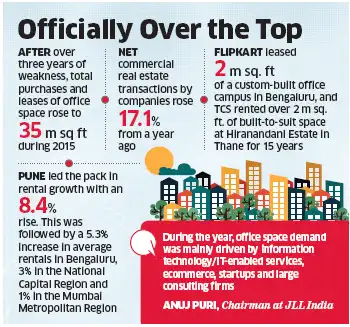
MUMBAI: The year 2015 marked a turnaround for India's commercial real estate as steady economic growth and renewed corporate confidence, especially among ecommerce and IT companies, propelled transactions to the secondhighest level in terms of area.

After over three years of weakness, total purchases and leases of office space in the top eight property markets rose to 35 million square feet during 2015. Net commercial real estate transactions by companies rose 17.1% from a year ago.

In 2011, a record 37 million sq. ft. of office space was taken up as rents eased after the global financial crisis. This time, however, it was the result of companies implementing growth plans, according to a report by property consultant Jones Lang LaSalle (JLL) India.

"During the year, office space demand was mainly driven by information technology/ITenabled services, ecommerce, startups and large consulting firms," said Anuj Puri, chairman at JLL India. "Players in many other sectors ..

Read more at:
http://economictimes.indiatimes.com/articleshow/50211241.cms?utm_source=contentofinterest&utm_medium=text&utm_campaign=cppst

Indian Realty Market Regains Favour of Foreign Investors: PwC

Source : NDTV PROFIT

Mumbai: A relaxed FDI (foreign direct investment) policy for the realty sector has reinforced the confidence of overseas investors and has helped India regain its place as one of the preferred investment destinations, according to a survey by PwC.
According to the global consultancy firm, the overall outlook for investments in Indian real estate market seems to be positive on account of the fact that 80 per cent of the foreign capital inflows have been all-equity buyouts by big institutional players.
It noted that even those investors who had burnt their fingers in the first round of investments in 2006-07 "are not wary of Indian markets anymore, and are willing to bet their money once again on the Indian real estate story". 
"The progressive evolution of Indian foreign investment policy for the real estate sector through introduction of various liberalisation measures has reinforced the confidence of foreign investors and has helped India regain favour to be one of the preferred investment destinations in the Asia Pacific region," PwC said.
The findings of the survey showed that Bengaluru is emerging as the real estate capital of India as it overtook Mumbai in this year's rankings to become the most preferred real estate investment destination in India.
"While Mumbai and New Delhi have marginally dropped in rankings, from an investment prospect perspective, New Delhi ranks second and Mumbai ranks fifth in the buy recommendation rankings for industrial/distribution properties among the 22 cities covered," PwC India partner Abhishek Goenka said, citing the survey results.
"Furthermore, Mumbai ranks eighth and ninth, for office and residential buy recommendations, respectively. These numbers, in a way, indicate that the investment prospect rankings of these cities could move up and push into the 'top-10' bracket in the years to come," he added. 
Giving city-wise observations, the survey results said that the financial hub Mumbai is on a recovery path as far as the commercial real estate side is concerned.
"On residential end, there is currently a reasonable amount of oversupply in the suburbs; however, with recent slowdown of approvals for new projects, the oversupply situation could get addressed to certain extent," it noted. 
Meanwhile, the survey observed that New Delhi is expected to see the biggest pipeline, primarily due to Delhi-Mumbai Industrial Corridor.
Tokyo, Sydney, Melbourne, Osaka and Ho Chi Minh City emerged as the top five cities in the world in terms of investment and development prospects in their respective realty markets.
The survey was conducted across 22 cities in the world.

Wednesday, 16 December 2015

5 Best Locations in India to Invest in Land


What do food and owning land have in common?
We all love the variety of different foods and tastes and festivals of all religions are mainly looked forward to for the sweets and savouries that will be specially prepared.
We have just as much love about the land we own. Investing in real estate has been a sweet spot for Indians for many decades. And land in particular, has always given positive returns, beating even other forms of real estate investment.
 However, the key to making handsome returns on land purchase is to make the right choice of land. Locations with great growth potential or upcoming areas are ideal bets when you wish to purchase land.
Below are five such locales in India.
Jigani, Bangalore
This area is located in South Bangalore and has shown tremendous improvement in recent times. Located along the State Highway 87 and National Highway 7, Jigani is situated near important hubs in Bangalore such as, Bannerghatta, Electronic city and Bommasandra. The growth of infrastructure has also been commendable in this area.
Despite the higher growth witnessed in this area, prices are still comparatively lower than other parts of Bangalore, indicating further potential for growth. This can therefore be a good area for land investment for investors, keeping in mind proximity to important locations, good infrastructure and relatively lower current prices.
Ambegaon, Pune
Ambegaon is located on the outskirts of Pune and offers a good valuation investment proposition. It is connected well to the inner city as well as to the Mumbai – Bangalore bypass. Ambegaon also falls within Pune corporation limits, thus indicating a good chance of getting better infrastructure compared to other areas in the outskirts.
In addition to boasting good schools, Ambegaon is also located close to new MIDC in Shirval, which is an industrialised area. The area is also known for its greenery and natural beauty.
Guduvancheri, Chennai
Chennai is a developed market in terms of real estate. However, there is lot of potential for growth of the market in the outskirts. After Oragadam and Sriperumbudur, Guduvancheri is an upcoming real estate hub in the outskirts of Chennai. This locale is situated along the Chennai – Trichy highway and has become a fast developing residential area between Tambaram and Chengalpet. It has especially seen a high demand for plots in the recent past owing to well established basic infrastructure, such as schools and markets.
There has been a development of industrial and IT industries near Guduvancheri. This area is close to Sriram IT Park, Estancia and Mahindra City, which host several companies. This has been an important reason for growth in the region.
Another reason is that prices are still affordable compared to nearby areas and people view it as a high growth potential area. In addition, other infrastructures such as bus and train facilities are also in place.
Rajarhat New Town, Kolkata
This is located on the outskirts of Kolkata and is a fast growing satellite city planned by the West Bengal government. Consisting of two villages, Rajarhat and Bhangar, this area is being developed in the north eastern parts of Kolkata. This is about three times the size of Salt Lake and is home to many IT companies. Corporates have purchased land in this area with plans of developing them at a later date. It is already home to many residential and commercial projects.
Infrastructure is also being planned, keeping in mind the future envisaged development. New town is very close to the airport, thus offering air connectivity. The area also offers good entertainment options. Considering the land parcels being acquired by corporates and builders, it is expected that this area will develop well in the coming years. This makes it an attractive investment destination. 
Indore Smart city
The Narendra Modi government has given the intention of developing 100 smart cities in the country to decongest the crowded metros. One among them is the Indore smart city project, which is an important project in Madhya Pradesh.
This smart city has been envisaged on 300 acres non processing area of the Indore special economic zone. The smart city is proposed to be a self sufficient township with all amenities and infrastructure. Purchasing land parcels around this area can help in reaping benefits of the development of the SEZ in general and the smart city in particular.
Land is not just an investment with a high potential, it is also a highly risky investment proposition. Not every land parcel you buy can give you great returns. It is also always advisable to understand all legalities and check papers for genuineness before purchasing land. How about some mithai for all the profits you make?

Ahmedabad metro to push city’s real estate market


Apart from a suitable budget and a strategic location, physical infrastructure also plays an important roll in the decision of buying a property. The approval for the Ahmedabad Metro Rail Project Phase-1 is expected to lift the real estate market of the city.
The metro phase 1 stretch covers two corridors – the North-South corridor starting from APMC, Vasna to Motera Stadium followed by the East-West corridor starting from Thaltej Gam to Vastral Gam.
If you are planning to buy a house in Ahmedabad, then localities near the upcoming Ahmedabad to Gandhinagar metro belt can be considered for good returns. “In almost all metropolitan cities across India, investing near the metro connectivity is considered ideal in terms of price appreciation and easy commute. Rapidly developing Ahmedabad has one more reason for the face-lift of its real estate sector,” says Nikunj Jani, lead consultant, Capital realtors.
Connectivity directly affects a buyer’s decision of selecting a locality. The upcoming metro belt will pass through the main city of Ahmedabad to the hub of IT and electronics industry (Gandhinagar). It will decongest some of the traffic marred areas of the city and will also ensure rapid connectivity to commuters.
Would the new metro lines affect property prices?
“The prices of property near the metro stretch have already started witnessing a rise and in future are expected to go up further. However, at present, the rental market stays unaffected” adds Jani. The middle class is expected to invest in these areas as home buyers from this segment prefer to live in areas having good metro connectivity.
“The returns on investment in areas within close proximity to the new metro routes are expected to be high. Many individuals already living in their own accommodation in Ahmedabad are banking on properties near the metro belt, to enjoy healthy returns once the metro is functional,” says Jitendra Soni, consultant, Harshil Estate.
Would the metro line bring new construction plans?
The upcoming metro belt comes with a scope of new development in areas with available vacant land. Hiren Patil, a local realtor at Disha Estate Management says, “Areas such as Hebatpur, Sindhu Bhavan Road and 5 km from Thaltej metro station, land is available where developers are planning to come up with residential housing projects.”
All these areas are within 3-6 km radius from the upcoming Thaltej Gam Metro Station. Prior to the announcement of the metro, these areas had a sizeable demand for housing but with the coming of the metro, the area is expected to witness more development and investments.
Upcoming metro routes
Localities to become accessible due to the upcoming metro are Motera Stadium, Sabarmati, AEC, Sabarmati Railway Station, Ranip, Juna Vajad, Usmanpura, Ashram Road, Nava Gandhigram, Madalpur, Paldi, Anjali, Vasna, APMC, Thaltej, Doordarshan Kendra, Gurukul Road, Commerce Six Road, Stadium, Ashram Road, Shahpur, Gheekanta, Kalupur Railway Station, Kanakaria East, Apparel park, Amraiwadi, Rabri Colony, Vastral and Nirat Cross Road.
Both buyers and investors have ample reasons to invest in Ahmedabad, with the new metro line set to bring enhanced connectivity and might work as an added reason for investment.
Source: ET

Tuesday, 15 December 2015

News Corp property website is acquiring rival to gain Asia presence

SYDNEY: News Corp's Australian real estate website company REA Group Ltd said it plans to buy out smaller rival iProperty Group Ltd for A$580 million ($414 million), seizing on the target company's footprint in Southeast Asia.

The deal would give News Corp exposure to property markets of Thailand, Indonesia, Malaysia and Hong Kong just as Australian real estate advertisers like REA brace for a downturn at home following several years of double-digit growth.

In a statement, REA Group said it plans to pay A$4 per share for the 77.3% of iProperty that it does not already own, giving the target company a market capitalisation of A$751 million. iProperty would recommend the deal in the absence of a better offer.


iProperty shares jumped as much as 11% in a weaker overall market to A$3.90, their highest since March 2014. REA shares rose 1.3%.

Douglas Loh, a portfolio manager at Acorn Capital, iProperty's third-largest shareholder with 4.7%, said the offer was below the target company's share price 20 months ago and that the acquisition would benefit REA by giving access to new growing markets.

Continue 

Monday, 14 December 2015

Housing Prices Down 15-20%, No Scope for Further Cut: Industry Body

New Delhi: Housing prices have fallen by an average 15-20 per cent across the country in last 18 months and there is no scope for further reduction, realtors' apex body CREDAI said on Wednesday.

Housing sales have improved by 15 per cent during the festive season helped by a fall in price and lower interest rate on home loans, still about 25-30 per cent of the total units launched are unsold, CREDAI president Getamber Anand told reporters here.

In order to boost the growth of the sluggish real estate sector, the association sought that the central and state governments rationalise tax structure on the property sector and adopt single-window approval for projects.

"We are seeing improvement in the demand. Prices have come down by 15-20 per cent in last one and half years and there is no further scope for reduction," Mr Anand said, adding that sales in this year's festival season increased by 15 per cent.

On unsold inventories, Mr Anand said the 25-30 per cent of the total housing launched would be unsold at present but he did not give any number.

CREDAI has tied up with rating agency CRISIL for providing regular data on real estate sector including new launches, sales and unsold inventories.

Listing out the industry's demand on tax-structure, CREDAI said the contractors should be held responsible for non-payments of PF/ESI to labourers instead of developers as the principal employers.

"We have been raided by the officials of provident fund department. If contractors do not pay, we are held responsible," Mr Anand said.

CREDAI vice president Rohit Raj Modi said there is a duplication of tax in form of ESI/PF as the industry already pays one per cent labour cess to the government and about Rs. 27,000 crore are lying idle in that account.

"We want ease of doing business. Compliances are too much, which delays the projects. We want single window approval and simplification of tax," CREDAI NCR president Manoj Gaur said.

On the proposed GST law, the association said the industry should not be subjected to both GST rate and stamp duties.

CREDAI president Mr Anand said that out of the total cost, about Rs. 350 per square foot goes into taxation.

The association also questioned the directives of state level green panel SEAC to spend 2 per cent of project cost on the CSR activities.

CREDAI would  flag these issue with the representatives of central and state governments during its two-days annual conclave on December 16-17 in the national capital.

source

Saturday, 12 December 2015

Real estate: Propeller of growth for Indian economy

Aman Agarwal KV Developers The real estate sector has been the backbone of the Indian economy and has been a major contributor in the economic growth. It is evident from the very fact that the Real Estate Sector contributes 8.53% of the total GDP and also witnessed growth rate to the tune of 30%. It is also pertinent to note that this sector has emerged as the fifth largest destination of foreign investment. The out of box thinking approach followed by real estate developers have been instrumental in changing the face of India from being an under-developed country towards accelerating its way to a developed country by developing the state of art infrastructure developments, buildings, townships, shopping malls not only in the urban towns of the country but in the Tier II & Tier III towns as well. This effort of developers has not only been useful in changing the face of India but infact has been providing sustenance to 250 ancillary industries. The road doesn’t end here as this sector has also been a good employer, by being the second largest employment generator in the economy where the top five real estate players employ more than 2.00.000 employees at different locations and being the highest employer to the BPL families. Nowadays with the changing attitude of people from living on rent towards owning their property the real estate sector has witnessed huge demand for the residential segment. The demand for commercial development is also growing at a fast pace due to a paradigm shift from unorganized retail towards organized retail coupled with MNC’s interest in establishing offices here in India. Going forward, the scenario would be no different as at present there is a shortage of almost 27 million dwelling units and the Indian real estate business which is estimated at USD 15 billion is likely to be USD 90 billion by 2015, predicts ASSOCHAM. The housing start-up index, which is now at a pilot stage, shows that new housing units in cities such as Kolkata, Chennai and Bangalore are showing lesser growth than the tier II and III cities like Lucknow, Indore, and Patna etc. Reason being the growth these cities are posing in terms of their absolute business. As per latest Knight Frank report, since last 2-3 months the Indian economy has witnessed improvement in all the economic parameters be it inflation, IIP, imports, CAD, etc. However, for the second largest populous country, job creation is of utmost importance for it to return to its high GDP growth levels. Job creation primarily depends on the labour intensive manufacturing sector which in turn depends on the investment in this sector. Fresh investments in the economy have been overshadowed by the upcoming general elections despite improved economic conditions. Economic and political stability are the vital catalysts for revival of the real estate sector in India. In addition, revival of this sector also depends on the regional policies like VAT, land acquisition and other regulatory policies. In this current scenario where the Rupee is still on the higher side, inflation is yet to reach comfort level and the Indian financial system is caught amidst liquidity trap, we developers can not meet the burgeoning demand from customers without the government’s support. Thus, in order to meet the growing demand, we require the support of government by relaxation of norms to facilitate the growth of the Indian real estate sector. The RBI should also intervene by reducing Bank repo rates to another 100-200 basis points and to further reduce CRR in order to infuse additional liquidity in the cash starved market. Also for the prosperity of the sector at general and customers at large the government should facilitate the efforts of real estate developers by providing minimum infrastructure guarantee under habitation policy, relaxing guidelines on foreign investing in Indian Realty, reducing risk weightage and by giving the sector industry status coupled with reduction and uniformity in stamp duty. Immediate need is also to do away with the restrictions on real estate loans. Thus it is my firm belief that with our continued growth driven strategies and activities coupled with due attention and support from all-government, banks, bureaucrats and media we will be able to withstand any type of market conditions and would be playing key role in taking Indian economy to next level.

Read more at: http://www.moneycontrol.com/news/real-estate/real-estate-propellergrowth-for-indian-economy_1073556.html#anchore_top_strip?utm_source=ref_article

Monday, 7 December 2015

Land Pooling: Creating cohesion out of fragmentation

Rohan Sharma JLL India “Buy land, they're not making it anymore” – Mark Twain Twain's pithy quote rings a conflicting note in the India of today. Land remains one of the most prized physical assets; its non-diminishing economic value increases manifold when it or even its surroundings are developed. As cities grow and the need for capacity building in infrastructure and providing land for economic activities increases, governments have had to resort to acquiring land owned by private citizens. Land acquisition has been a contentious policy arena, as it largely falls under individual states which have typically followed the compulsory acquisition route, with compensation based on the land reference rates determined in each state and municipality by the local authorities. These reference rates are invariably anomalous and largely de-linked from market realities. In certain cases, the state governments have auctioned such acquired land to private parties for much higher prices than the meager compensation paid to the original landowners. In short, the economic benefits arising from land have historically been appropriated by the government, its agencies or private parties. The interests of the original title-holders have been marginalised. Despite different compensation formulae devised by different states, land acquisition has so far remained a contentious issue, and has of late spawned numerous people’s movements, public interest litigations and protests over the denial of the benefits arising from such land to its first owners. This murky scenario has prompted the governments to look at alternate methods of sourcing and developing land which allow the landowners to partner in and benefit from the development process. Enter the concept of ‘land pooling’. What Is Land Pooling? Land pooling results in equitable and efficient land development. It is actually a means of readjusting uneven land distribution by bringing fragmented land holdings together to constitute a larger land parcel. Consequently, infrastructure is developed on the land, and it is then returned to the original owner/s after applying a formula. This formula compensates the authority or the entity which undertook the development for the infrastructure and other provided services by allowing them to sell or retain a part of the original land. Though seemingly complicated, this approach is actually a highly effective way of achieving development while simultaneously promoting social justice. Land pooling involves participation of the national and state governments for policy formulation, notifications, approvals and creation of operational norms. The local agency will receive blanket assistance from various government departments, and is responsible for creating a proper land valuation mechanism to encourage the participation of land owners. In this manner, land pooling creates an ecosystem for planned development through infrastructural projects supporting urban area growth, and is an efficient means of combining smaller, irregular land holdings into larger, developed wholes which can serve as new urban areas. By turning landowners into stakeholders in land development through unlocking of their land value and passing on the majority of the benefits to them, the state creates a model of social empowerment and growth while ensuring sustainable development. Multiple Benefits: •The land pooling process incentivises the private sector to become a willing participant in development •It does way with bottlenecks of long land acquisition negotiations, and heavy compensation monies •The state also benefits by saving money which it would otherwise have spent on compensation pay-outs •More importantly, the state can avoid legal wrangles related to rehabilitation and resettlement of dispossessed land-holders, and protests which can arise from the forcible or compulsory land acquisition method. •The land pooling concept helps unlock previously fragmented land holdings and free up additional land which, in semi-urban and urban fringe areas, can be effectively utilised for creating affordable, low-cost housing through development norms which may be prescribed as part of this policy •It also allows for creation of newer centres for commercial growth, thus helping to create employment opportunities. Finally, the land pooling method also leads to a robust way to create and maintain land title ownership records. This, in turn, creates a transparent registry system, which will even enhance land revenues for the local bodies to undertake more projects for public benefit. With apologies to Mr. Twain, a more constructive approach to solving India's land acquisition conundrum would be: "Don’t buy land, pool it - the developed whole makes more sense than the sum of its fragmented parts."

Read more at: http://www.moneycontrol.com/news/real-estate/land-pooling-creating-cohesion-outfragmentation_3858241.html#anchore_top_strip?utm_source=ref_article

Sunday, 6 December 2015

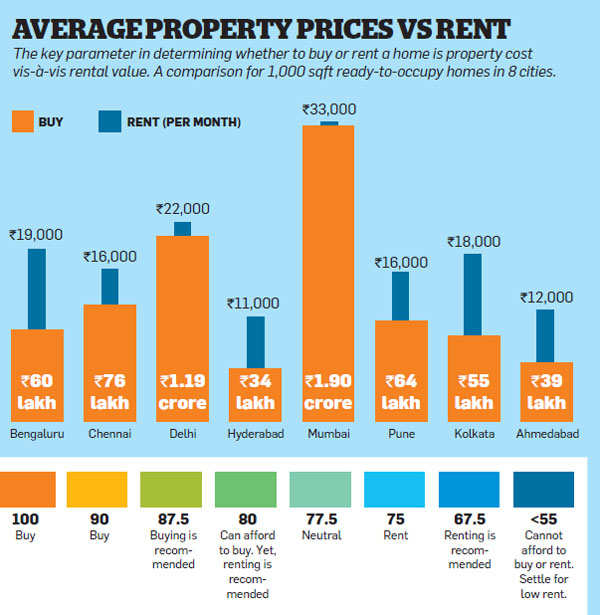
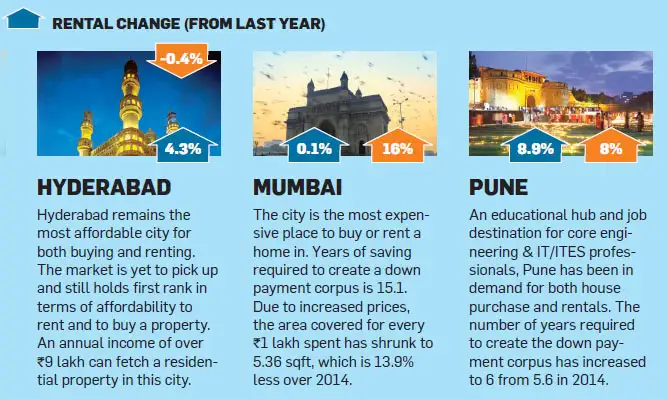
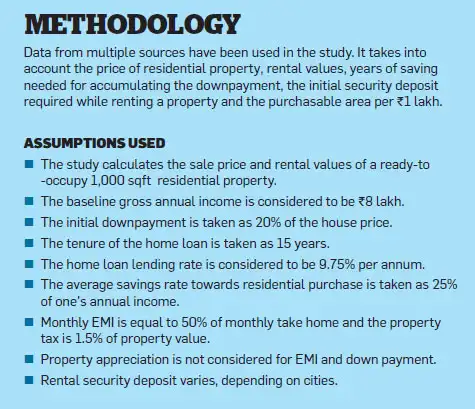
Should you buy or rent a house

ArthaYantra Buy Vs Rent Report 2016 looks at 8 cities across India to find out where buying is affordable and where living on rent is cost-effective.
Source
ArthaYantra Buy Vs Rent Report 2016 looks at 8 cities across India to find out where buying is affordable and where living on rent is cost-effective.

prices to remain resilient in 2016 - Fitch expects residential property


MUMBAI: Fitch Ratings has said that it expected residential property prices to remain stable as builders are option to offer easy payment solutions rather than lowering prices. This was indicated by Fitch Ratings on Monday in a report on the 'Outlook 2016: Indian Home builders.

'Residential property prices should remain resilient in 2016, supported by improving demand. Home builders have been reluctant to reduce prices, and have instead used easy-payment schemes to woo buyers," said F ..

Thursday, 3 December 2015

Nasik real estate: High investment potential


Nasik has a four-fold economic configuration - pilgrimage economy, industrial economy, defense sector economy and a strong agricultural economy. In terms of industry, Nasik has three well-developed industrial estates at Satpur, Ambad and Sinnar. Kishor Pate CMD, Amit Enterprises Expertise : Property More about the Expert... Kishor Pate Amit Enterprises Housing Nasik has been developing rapidly over last fifteen years. This city's multiple economic drivers include its proximity to Mumbai and its strategic location on the Central Railway main line and the Mumbai-Agra National Highway. Nasik is now a new centre of industries, commerce, administration, education, production and marketing. Basically, Nasik has a four-fold economic configuration - pilgrimage economy, industrial economy, defense sector economy and a strong agricultural economy. In terms of industry, Nasik has three well-developed industrial estates at Satpur, Ambad and Sinnar. The important industries situated in Nasik and its surroundings include ABB India, Mahindra and Mahindra, Gabriel, Glaxo SmithKline, LG Electronics, Samsonite, Garware, Siemens, Blow Plast, Thyssen Krupp, Ceat, Atlas Copco and TI Cycles. Real estate development in Nasik has been taking place in a very collaborative manner. In many cases, landlords with sizable agricultural land holdings on Nasik's fringe areas have either sold their land or entered into joint venture agreements with developers and moved farther for their agriculture activity, thus infusing land as well as capital into Nasik's real estate market. Residential projects such as Amit Eka by Amit Enterprises Housing Ltd. in the Pathardi area of South Nasik have been meeting with enthusiastic response, both locally and from out-station investors who find the property rates in Mumbai and Pune beyond their budgets. The areas along Pathardi Link Road are major developing residential destinations that see high demand by second home buyers. Overall, Nasik offers very encouraging fundamentals for real estate investors. Some of the advantages it enjoys over other several major cities in Maharashtra include:Well-developed physical infrastructure, Adequate and good quality water supply, Located at one vertex of the major growth triangle of Mumbai, Pune and Nasik, Comparatively lower environmental pollution, Efficient intra and intercity commuting facilities, Excellent connection with other regional growth centres, Developed industrial estates such as Ozar, Sinnar, Satpur and Ambad in the immediate vicinity, The Software Technology Park at Ambad, Salubrious year-round climate, A well-established Defense Base that gives Nasik a safe and secure social environment and also interactive national positioning with other Indian cities, Air connectivity with national cities, Generous and increasing availability of skilled labour Numerous high-grade healthcare facilities and educational institutions, also for higher and professional education Nasik’s future in terms of investments and economic growth is very promising, thanks to several projects underway or expected to confirm operations in Nasik in the near future. For instance, Hindustan Aeronautics has short-listed Nasik as the base for its Rs. 23000-crore manufacturing plant for Sukhoi jets for the Indian Air Force. Also, the IT/ITES sector in Nasik is rapidly becoming a force to reckon with. BPOs have begun recognizing Nasik as a very viable destination because of the lower real estate costs while at the same time being a very good catchment of educated, English-speaking talent. Several information technology companies are now firming up their plans for establishing bases in Nasik. Private banks have been major drivers for commercial real estate in Nasik, with ICICI, HDFC and HSBC having expanded their operations phenomenally. Moreover, the Government of Maharashtra is investing heavily into the already thriving Wine Parks industry in Nasik, which is already famous for Sula Vineyard. The general real estate trend in Nasik has been accelerating growth even in while turbulent economic conditions slowed down the markets in most other cities. This is amply borne out by the steady rise in construction and development activities. Developers in the city are displaying remarkable vision, having taken Mumbai, Ahmedabad, Surat, Pune and Bangalore as development models, replicating what works in these cities and conscientiously steering clear of what does not. All these factors are boosting employment and prosperity in Nasik, which directly influences the demand for residential real estate. Little wonder, then, that more and more investors are now focusing on this city. They are attracted by the low property rates and excellent mid and long-term demand projections.


Read more at: http://www.moneycontrol.com/news/real-estate/nasik-real-estate-high-investment-potential_1070176.html#anchore_top_strip?utm_source=ref_article